The Medical College Admission Test (MCAT) is a standardized test administered by the Association of American Medical Colleges (AAMC). As the primary assessment tool utilized by medical schools in the United States, Canada, and other countries, the MCAT helps admissions committees assess a candidate’s readiness for the rigorous journey of medical education.
#Sections and timing on the MCAT exam
The MCAT consists of four separately timed sections:
- Biological and Biochemical Foundations of Living Systems (59 questions)
- Chemical and Physical Foundations of Biological Systems (59 questions)
- Psychological, Social, and Biological Foundations of Behavior (59 questions)
- Critical Analysis and Reasoning Skills (CARS) (53 questions)
Test takers are given 95 minutes to complete the three science-based sections of the exam and 90 minutes to complete the CARS section.
The MCAT science sections evaluate test takers’ abilities to integrate foundational concepts from biology, chemistry, physics, psychology, and sociology with complex, passaged-based information. Most questions are paired with research or information-based passages that present unfamiliar concepts, data, and/or research findings. There are also several discrete questions in the science sections, which may likewise be paired with data and information that students must interpret.
The CARS section of the MCAT consists entirely of passage-based questions. CARS passages are NOT science-based passages. Instead, they cover diverse fields in the humanities and social sciences, such as literature, art history, philosophy, religion, anthropology, archeology, business economics, history, political science, and more. CARS passages require the test taker to both understand and evaluate opinions and arguments presented in these passages.
##What are the “foundational concepts” covered on the MCAT?
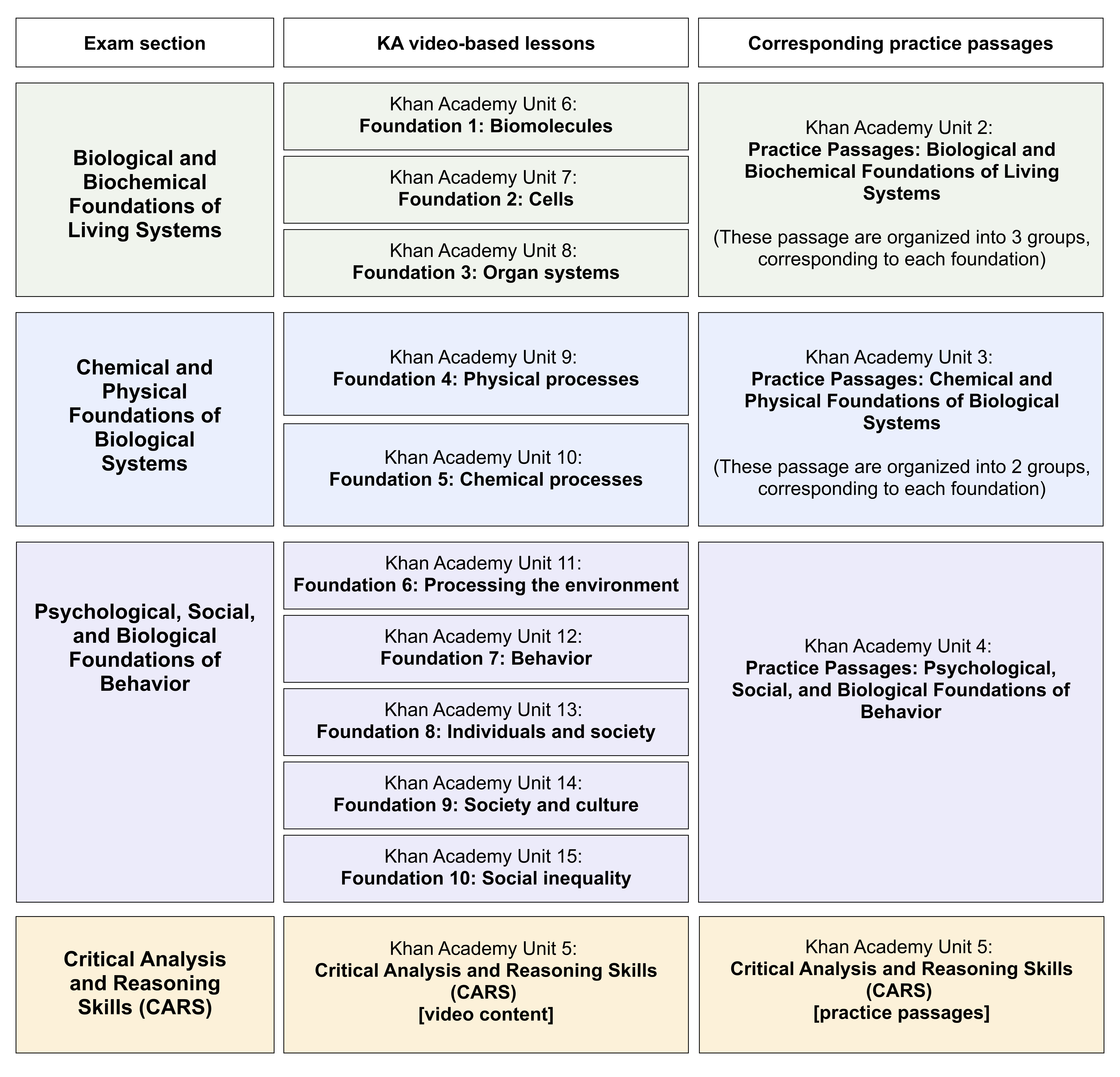
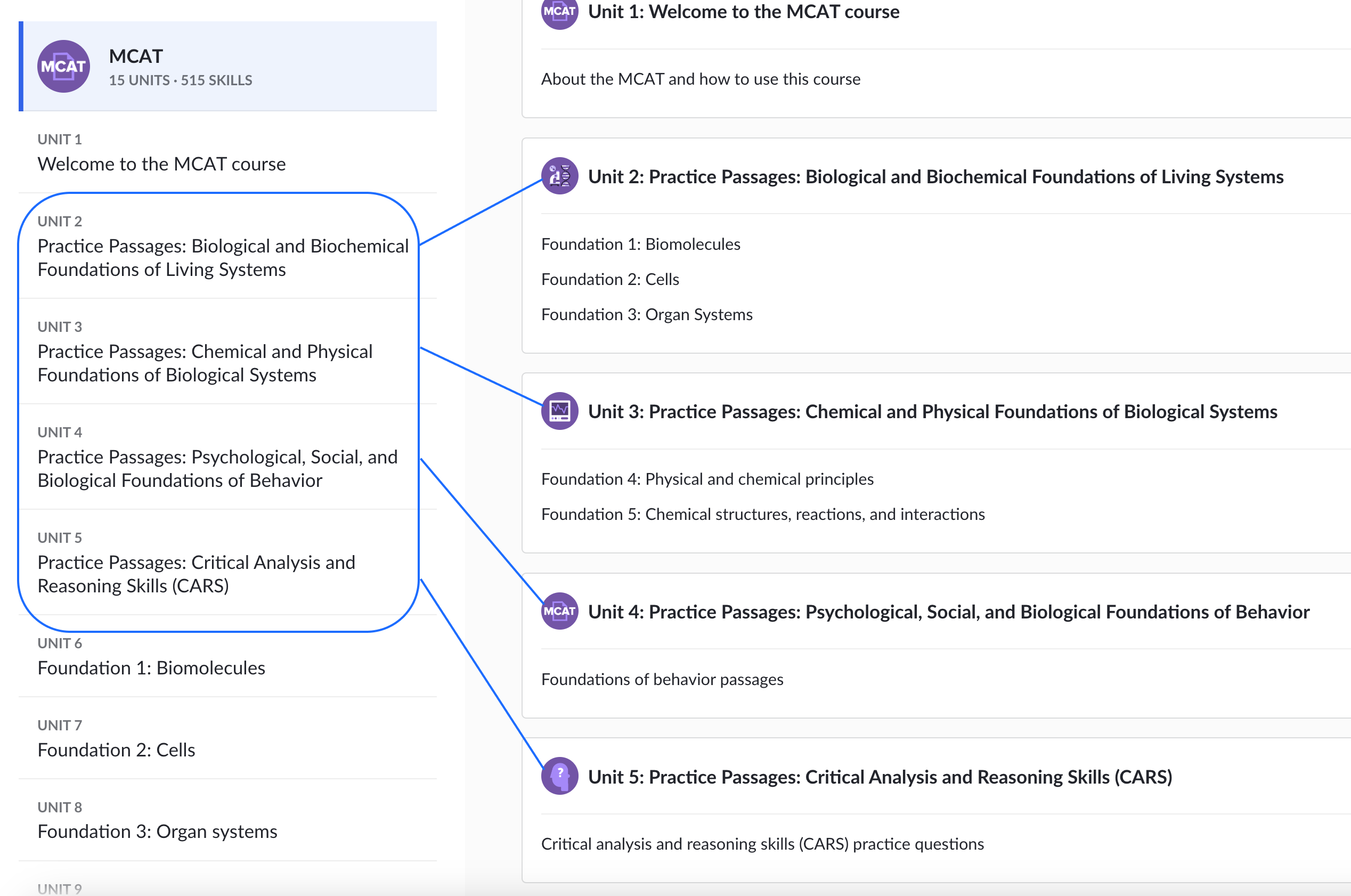
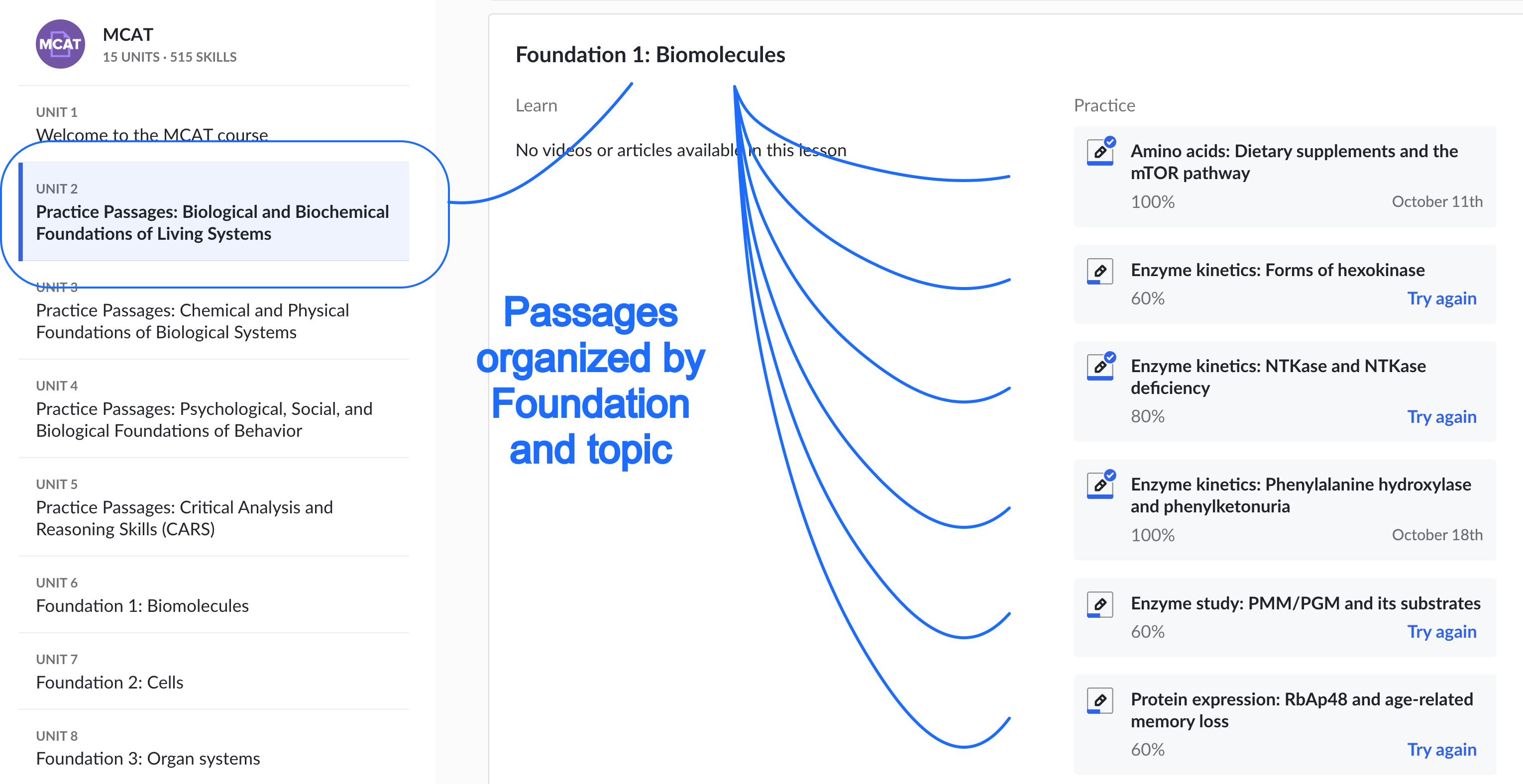
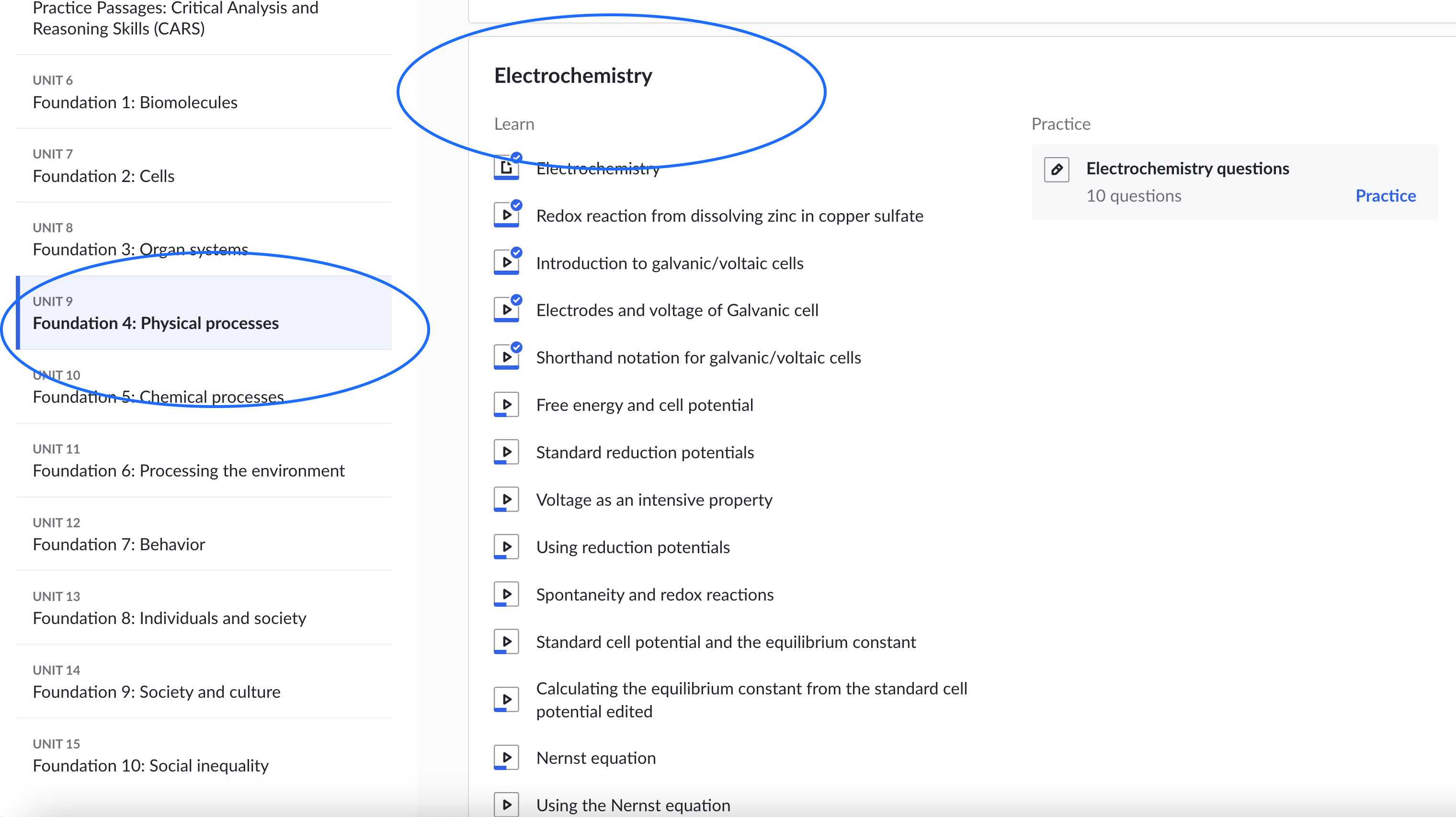
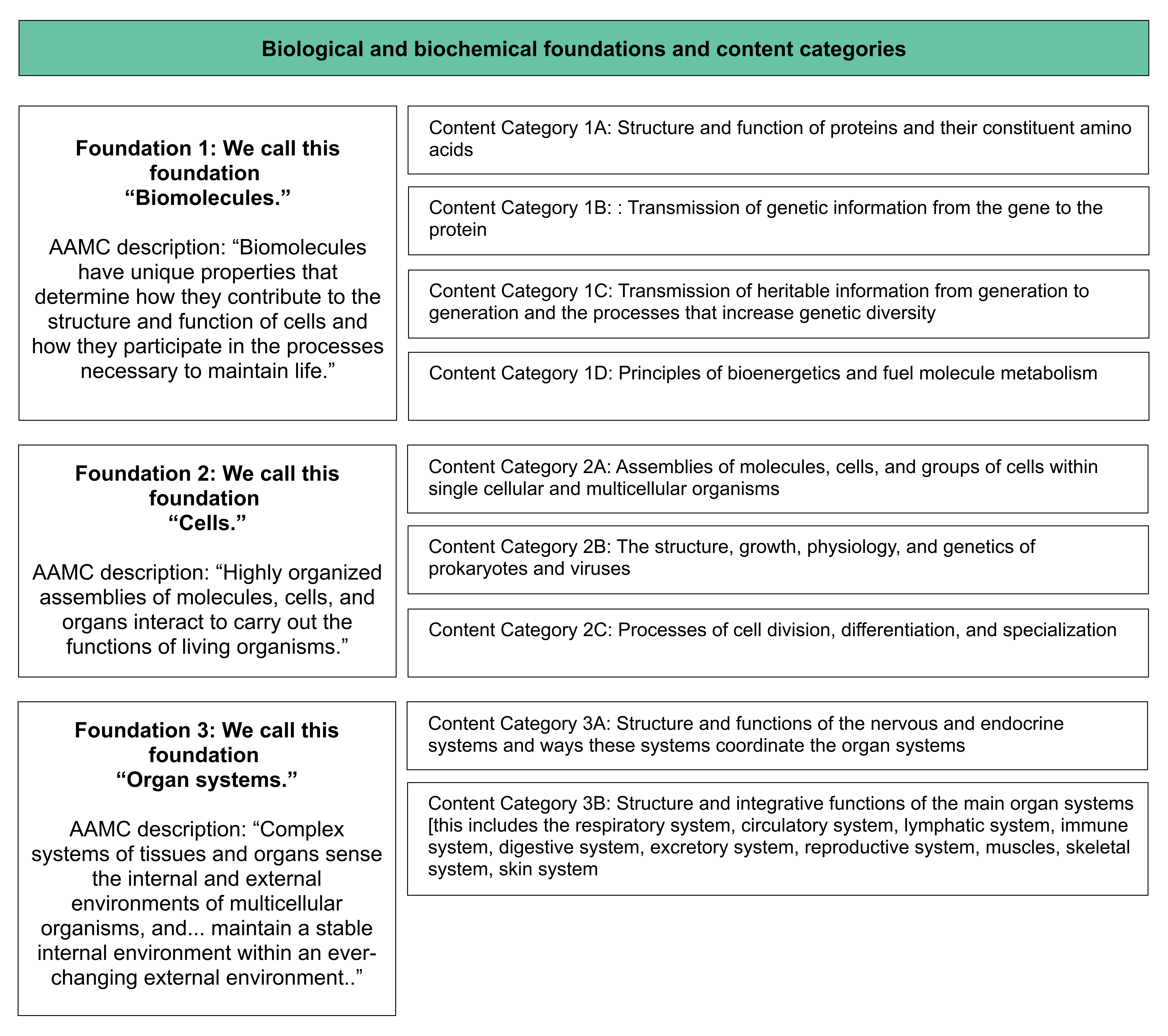
The science sections of the MCAT encompass several “foundational concepts,” or “foundations,” each of which is associated with several “content categories,” according to the AAMC MCAT content blueprint. The Khan Academy MCAT content is largely structured around these Foundations and therefore generally aligns with the AAMC content blueprint. Below is a summary of MCAT foundations and content categories.
First, the Biological and Biochemical Foundations of Living Systems section of the MCAT consists of three foundations, whose content categories are summarized below. The content covers biology and biochemistry topics within each of the foundations and content categories.
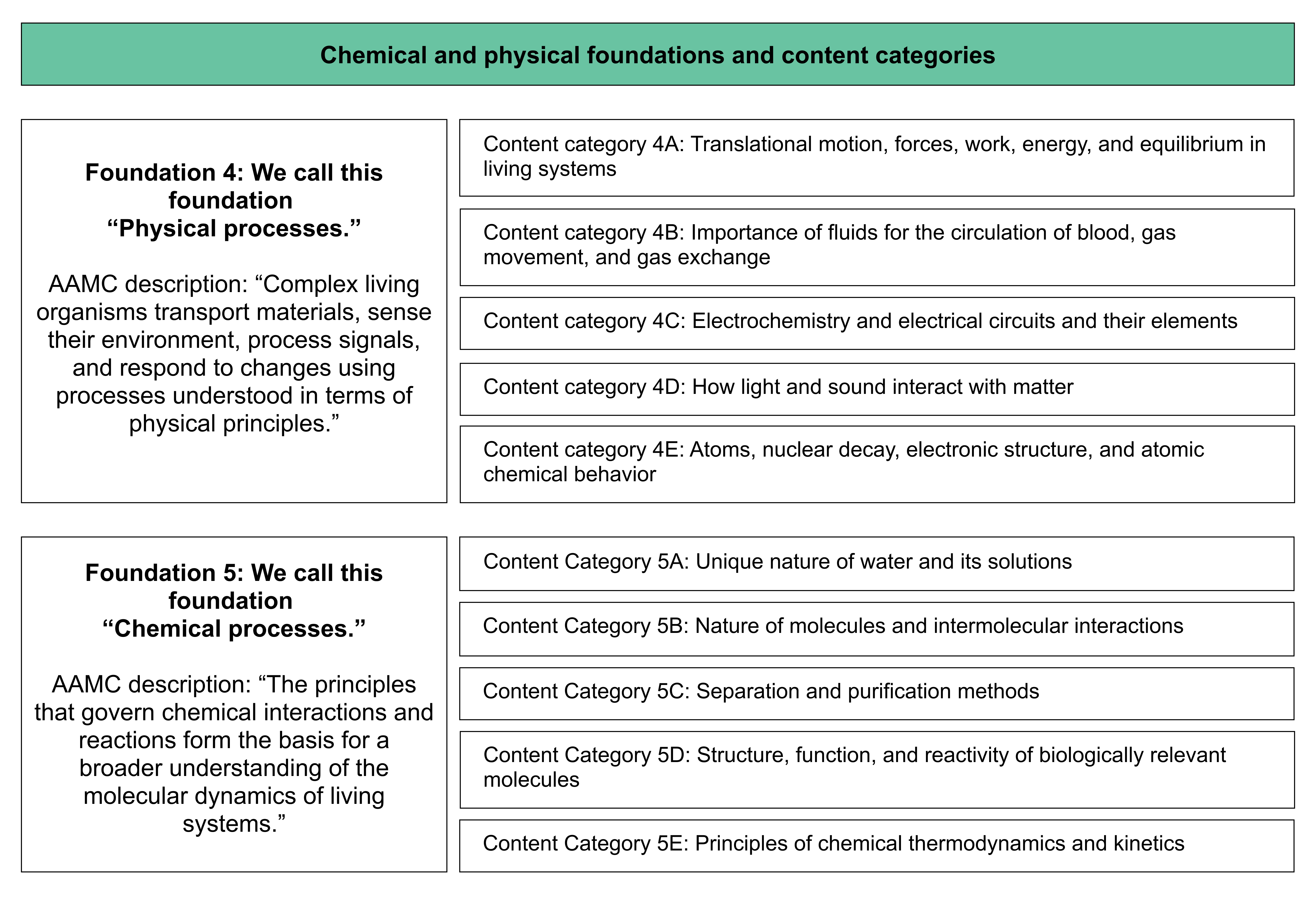
The Chemical and Physical Foundations of Biological Systems section of the MCAT consists of two foundations, whose content categories are again summarized below. The content covers physics, general chemistry, organic chemistry, and biochemistry topics within each of the foundations and content categories.
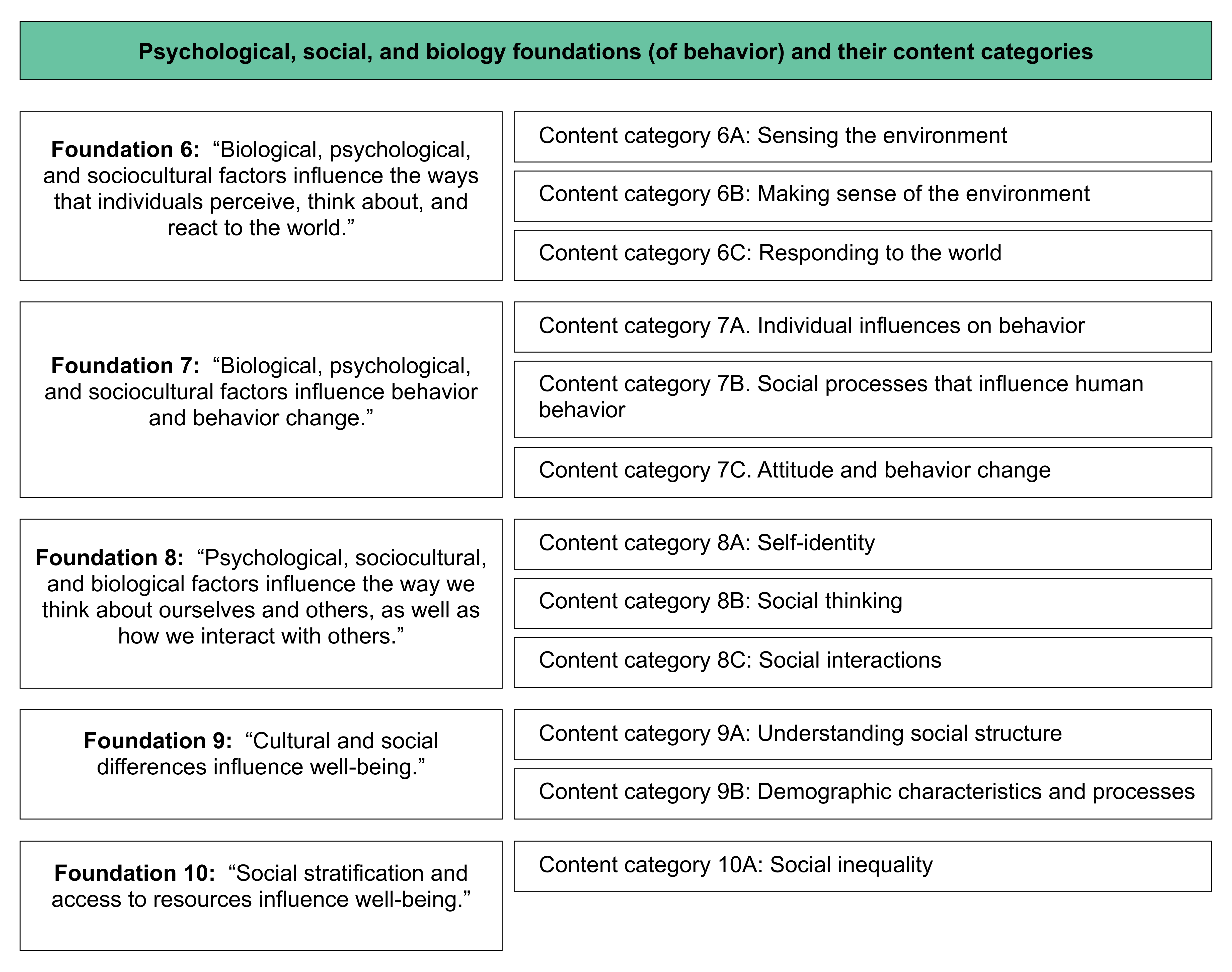
Lastly, the Psychological, Social, and Biological Foundations of Behavior section of the MCAT consists of five foundations, whose content categories are again summarized below. The content covers biology, psychology, and sociology topics pertaining to behavior within each of the foundations and content categories.
For more information about the content covered on the MCAT, see the AAMC MCAT guide.
##Question types on the MCAT
The science sections of the MCAT assess four general “Scientific Inquiry and Reasoning Skills (SIRS).” Each question can be assigned one of these skills:
-
SIRS Skill 1: Knowledge of Scientific Concepts and Principles: Questions in this skill category require you to “demonstrate your knowledge of the 10 foundational concepts” tested on the MCAT. Read more about SIRS Skill 1.
-
SIRS Skill 2: Scientific Reasoning and Problem-solving: Questions in this category require you to use your scientific knowledge to reason through problems. They may require you to explain or evaluate scientific arguments or theories, interpret pictures or diagrams, or solve problems using scientific formulas. Read more about SIRS Skill 2.
-
SIRS Skill 3: Reasoning about the Design and Execution of Research: Questions in this category require you to demonstrate your understanding of scientific methodology. For instance, they may require you to interpret types of variables, identify the best way to collect data, identify faulty research conclusions or confounding variables, or select the reasoning behind a certain research approach. Read more about SIRS Skill 3.
-
SIRS Skill 4: Data-based Statistical Reasoning: Questions in this category require you to read and interpret graphs, tables, charts, and other forms of data, as well as use statistical reasoning when appropriate. Read more about SIRS Skill 4.
The CARS section of the MCAT assesses “Critical Analysis and Reasoning Skills,” hence the name CARS. Each question on CARS can be assigned one of these skills:
-
CARS Skill 1: Foundations of Comprehension: These questions test your comprehension or understanding of what the author of the passage is saying. They may ask you, for instance, about overall passage meaning or central passage ideas, or about the meaning of specific paragraphs, phrases, or words. Read more about CARS Skill 1.
-
CARS Skill 2: Reasoning Within the Text: These questions may assess your ability to integrate different passage components into a more generalized interpretation of passage meaning, or they may ask you to recognize and evaluate arguments made in the passage. Read more about CARS Skill 2.
-
CARS Skill 3: Reasoning Beyond the Text: These questions may ask you to apply ideas from the passage to the interpretation of new situations or scenarios. Or, they may ask you to consider new information and determine how this integrates with or impacts ideas presented in the passage. Read more about CARS Skill 3.